16 Graphic Designer Resume Examples, Print to UX
- ATS Friendly
- Portfolio-First
- 16 Real Examples
A graphic designer resume has to do two jobs at once: show taste and still parse in an applicant tracking system. Pick a clean template below, add your portfolio link near the top, and model your own resume on a real example built for your specialty, from print and brand to UX, UI, and motion.


540k+ resumes created
Editable graphic designer resume templates
Each template below is a real designer resume laid out in that format, sorted by specialty. The visually rich layouts suit portfolio-forward roles like brand, motion, and art direction; the cleaner ATS-friendly layouts suit corporate, entry-level, and career-change applications that run through a company portal. Choose one, add your portfolio URL to the contact line, then swap in your own tools, metrics, and projects. Every layout keeps your name, contact details, and headings clean so a hiring manager reads your work fast and a parser reads your text without trouble.
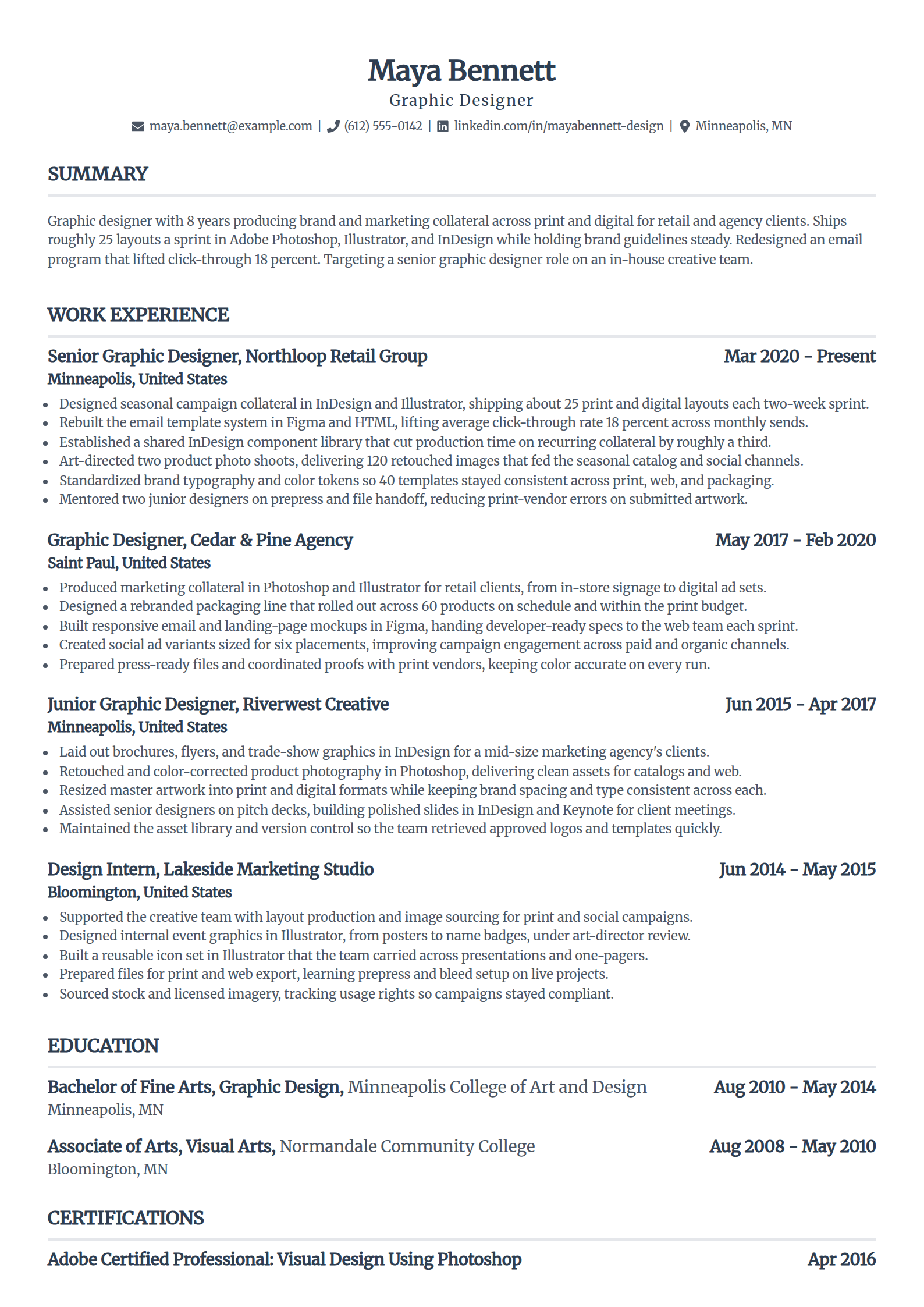
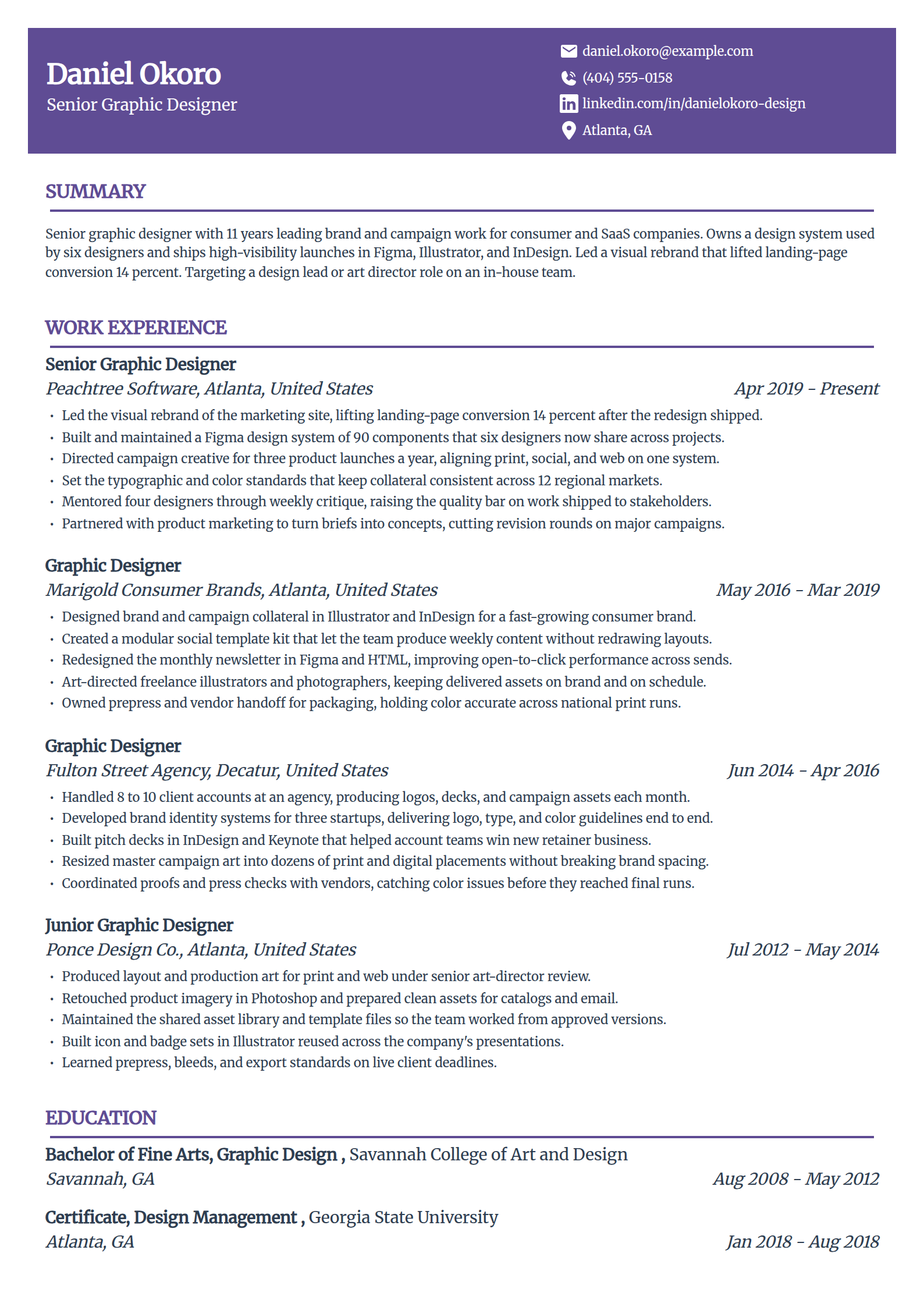
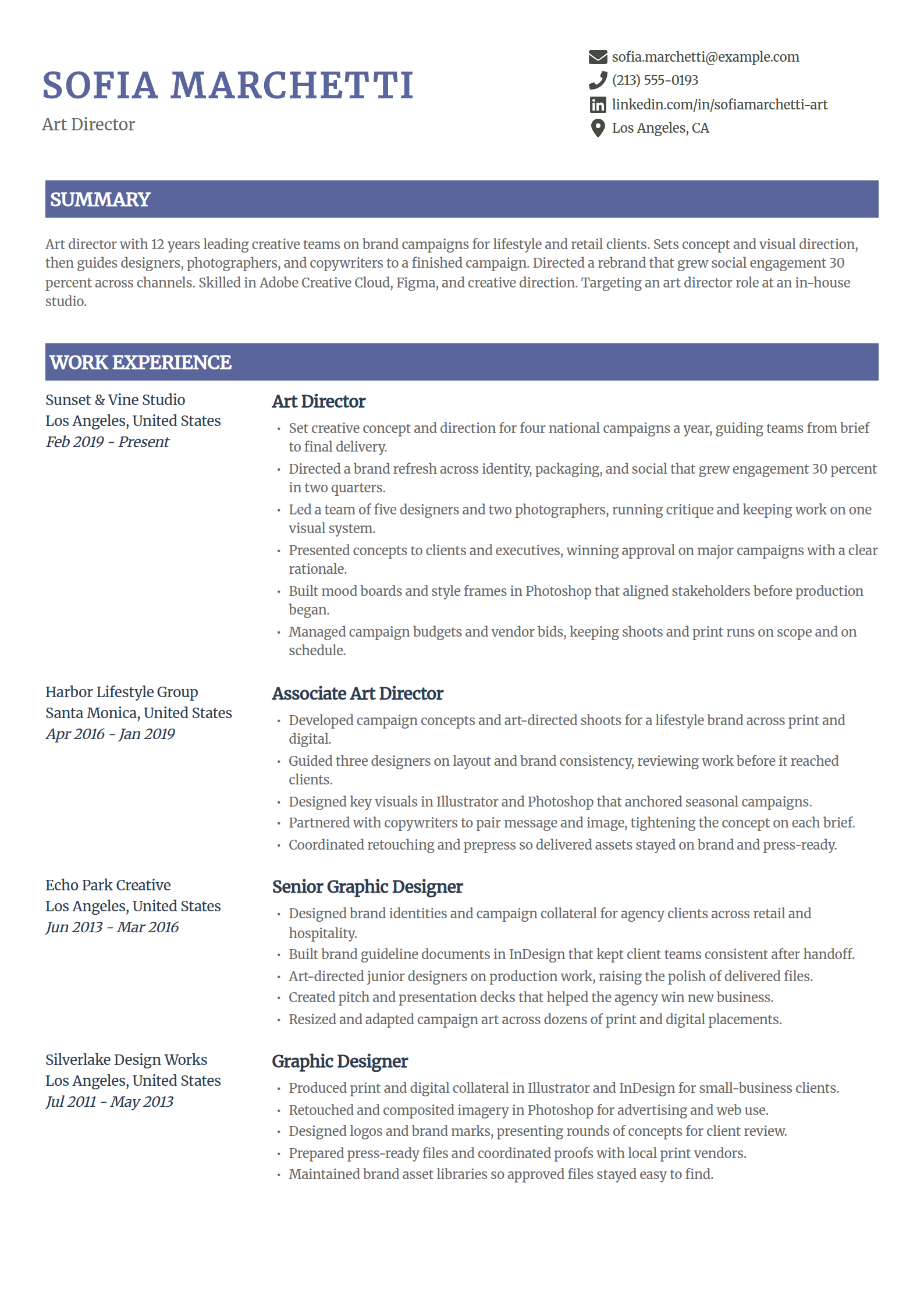
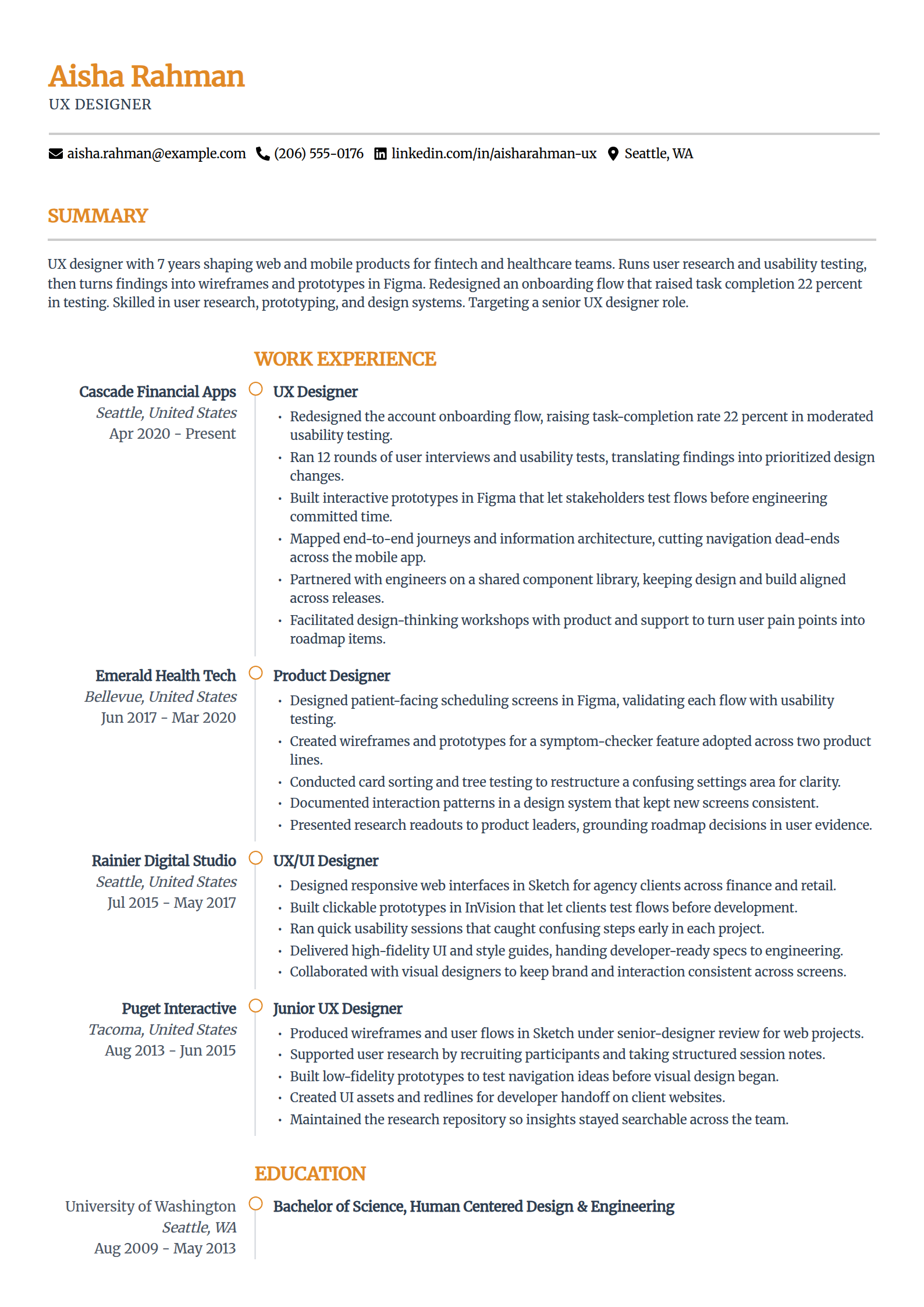
Experienced Graphic Designer Resume Template
Why this resume example works?
- Opens with a summary that names 8 years, about 25 layouts a sprint, and an 18 percent email lift, the scope a hiring manager reads first.
- Leads each bullet with a strong verb and one number, such as shipping 25 layouts a sprint or rolling out 60 product packages.
- Names the real print and digital stack, Adobe Photoshop, Illustrator, InDesign, and Figma, the keywords a posting lists.
- Uses a single-column layout with standard headings that an applicant tracking system parses cleanly.
- Backs the work with Adobe Certified Professional credentials near the bottom rather than a wall of adjectives.
Senior Graphic Designer Resume Template
Why this resume example works?
- Frames a senior scope up top, owning a design system used by six designers and a rebrand that lifted conversion 14 percent.
- Turns craft into leadership: building a 90-component Figma system, mentoring four designers, and setting brand standards.
- Balances team-management bullets with hands-on work so the resume reads as a working senior designer, not a title.
- Names a design-system and brand toolset that a modern in-house team looks for, from Figma to InDesign.
- Fills a dense layout with a clear climb from junior designer to senior across four roles.
Art Director & Lead Designer Resume Template
Why this resume example works?
- Leads with direction, not production: setting concept for four campaigns a year and a rebrand that grew engagement 30 percent.
- Shows the scope a creative lead owns, guiding a team of five designers and two photographers on one visual system.
- Keeps the hands-on craft visible, from mood boards and style frames to budget and vendor management.
- Uses a visually rich layout that signals design taste while staying readable for a hiring manager.
- Carries Adobe credentials and a clear path from designer to art director across the experience.
UX Designer Resume Template
Why this resume example works?
- Opens with product impact, an onboarding redesign that raised task completion 22 percent in usability testing.
- Names the UX process a posting screens for, user research, usability testing, wireframing, and prototyping in Figma.
- Shows research volume that reads as real practice, 12 rounds of interviews and tests feeding prioritized changes.
- Pairs research with a shared component library, proving the designer works with engineers, not just in isolation.
- Uses a clean, modern layout that parses well for the large employers where UX roles run through an ATS.
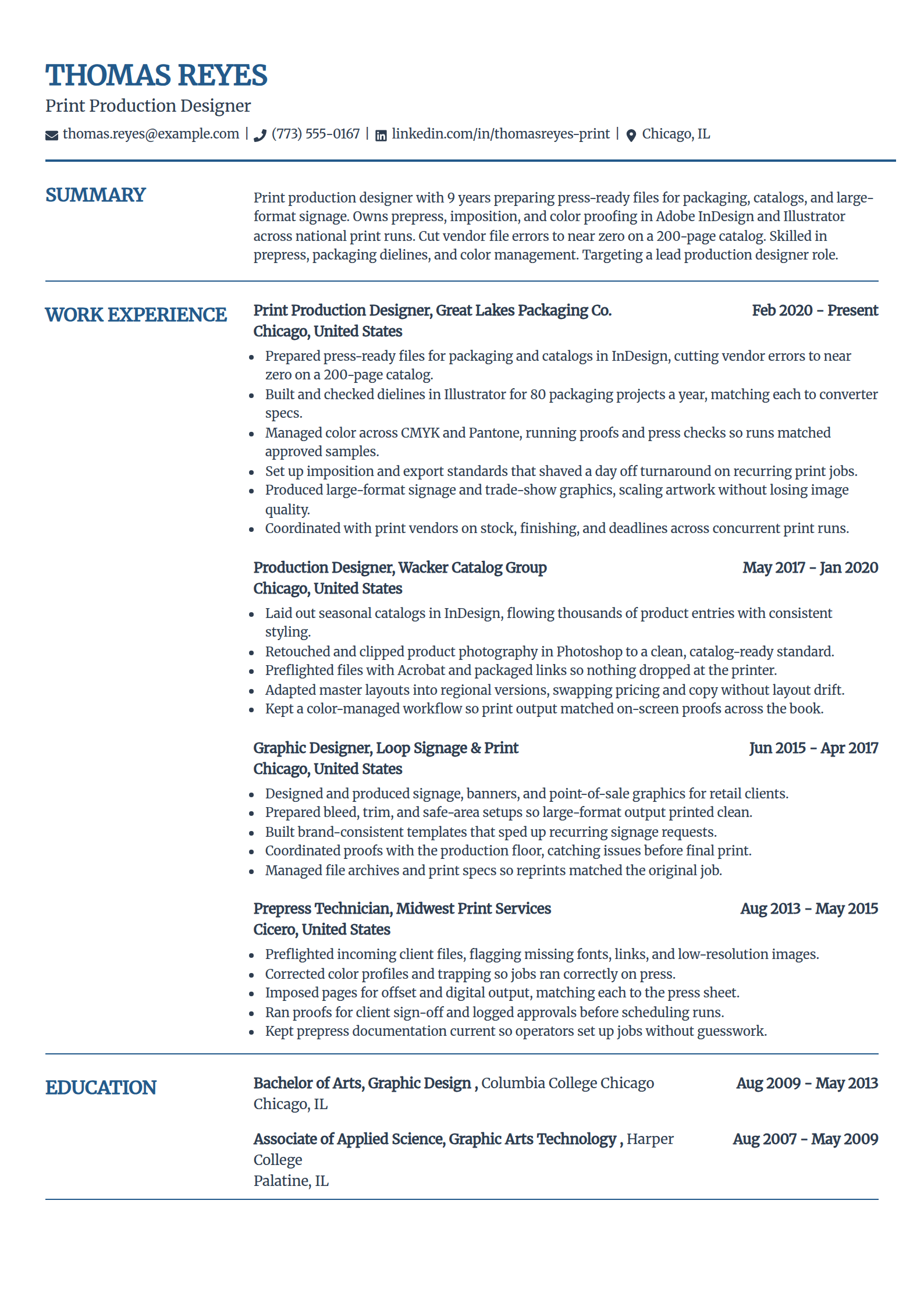
Print & Production Designer Resume Template
Why this resume example works?
- Leads with the work a print shop hires for, press-ready files that cut vendor errors to near zero on a 200-page catalog.
- Names the production toolset outright, InDesign, Illustrator, prepress, imposition, and Pantone color management.
- Shows format range a production role needs, from packaging dielines to large-format signage and point-of-sale.
- Keeps every bullet concrete and measurable, such as building dielines for 80 packaging projects a year.
- Uses a clean, modern layout that stays easy to parse for corporate and agency print teams.
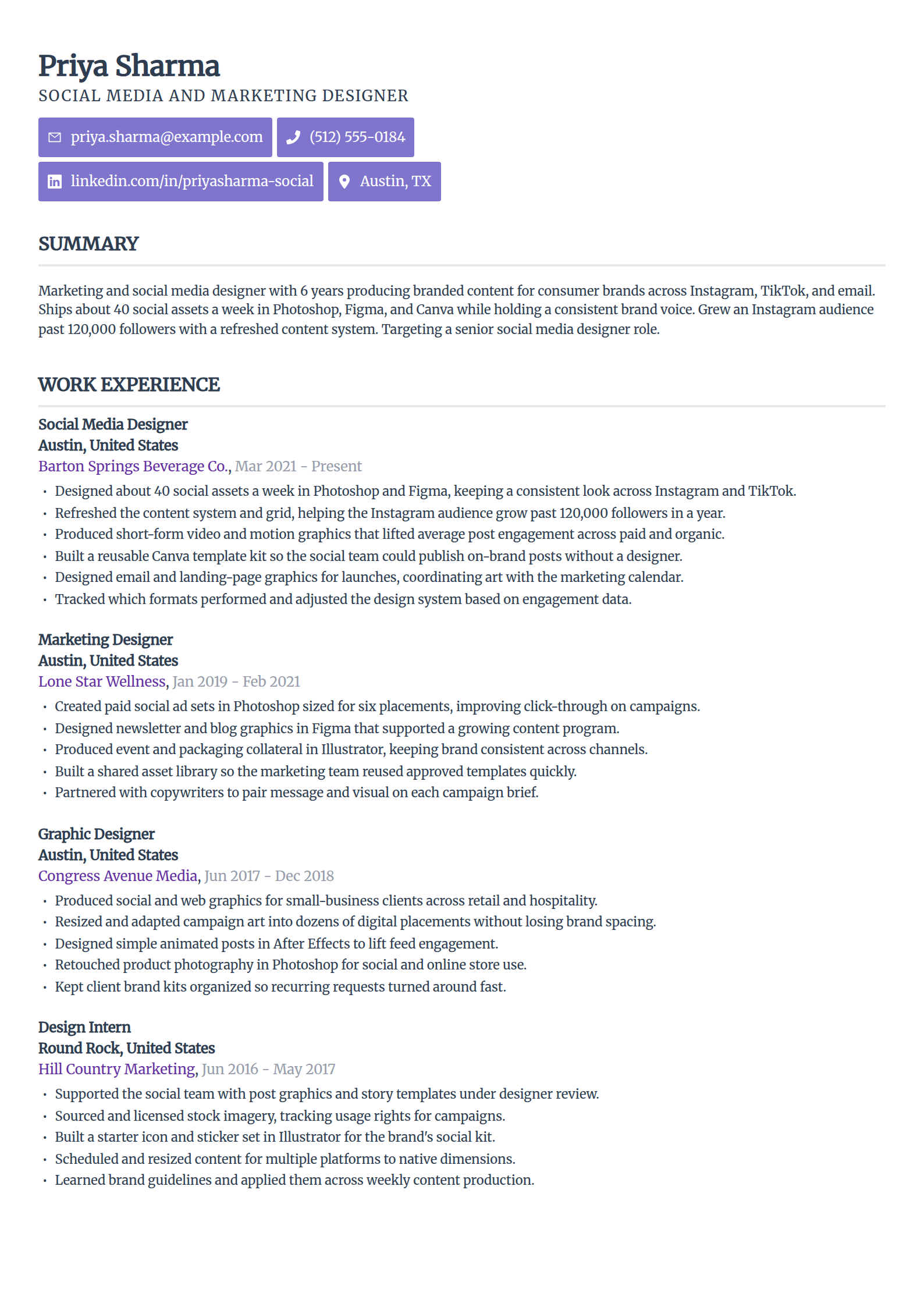
Marketing & Social Media Designer Resume Template
Why this resume example works?
- Opens with output and audience, about 40 social assets a week and an Instagram audience grown past 120,000 followers.
- Names the social and marketing stack, Photoshop, Figma, Canva, and After Effects, matching a content-team posting.
- Ties design to results a marketing team values, engagement lift and a reusable template kit the team publishes from.
- Shows platform fluency across Instagram, TikTok, and email rather than a generic design summary.
- Uses a clean, modern layout that reads fast and parses cleanly for in-house marketing roles.
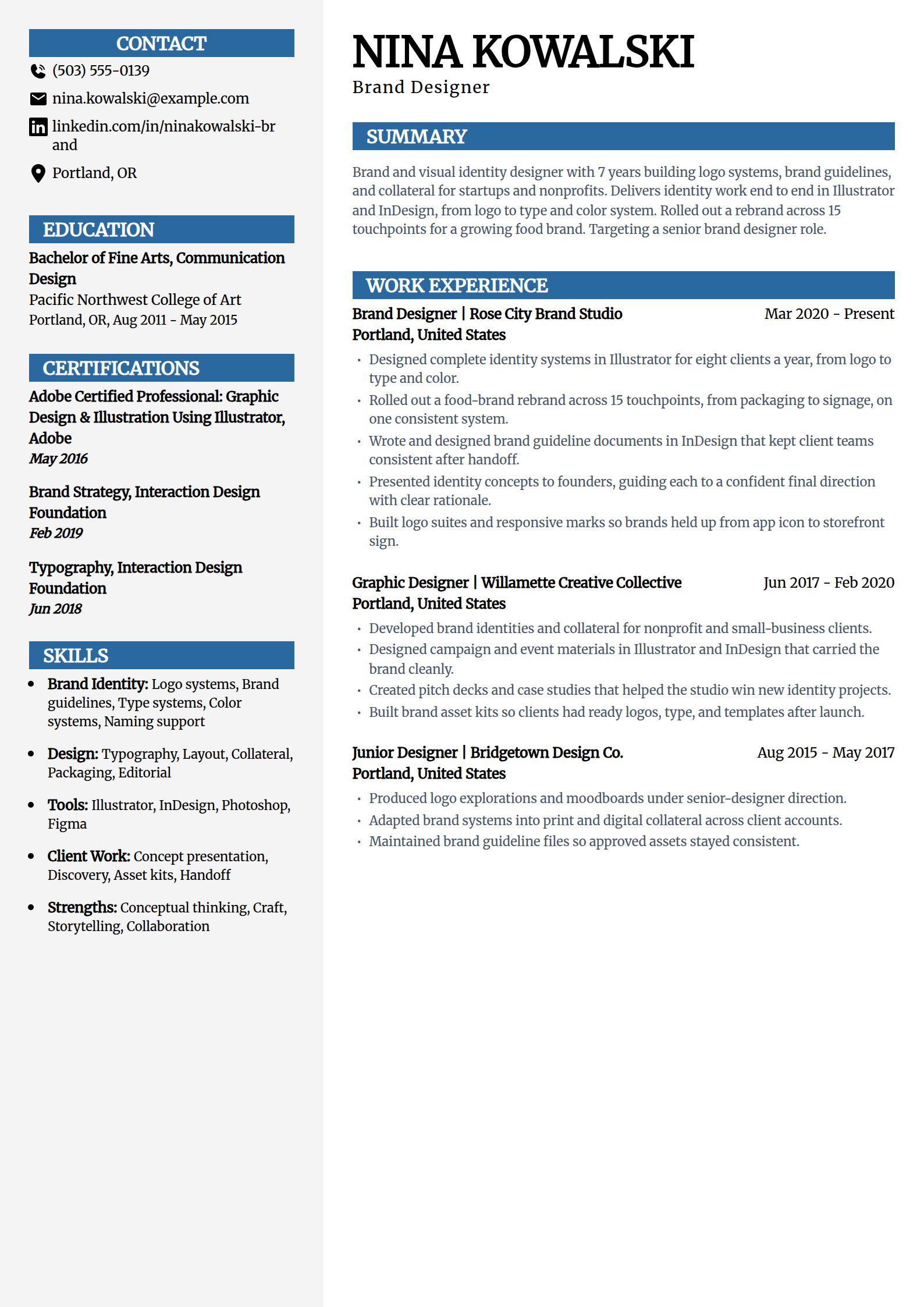
Brand & Visual Identity Designer Resume Template
Why this resume example works?
- Leads with identity work end to end, logo systems, type, and color, plus a rebrand rolled out across 15 touchpoints.
- Shows the deliverables a brand role owns, brand guideline documents that keep client teams consistent after handoff.
- Names Illustrator and InDesign alongside brand-strategy work, the exact mix an identity studio looks for.
- Uses a visually rich layout that demonstrates taste, fitting for a portfolio-forward brand designer.
- Keeps metrics modest and believable, such as delivering complete identity systems for eight clients a year.
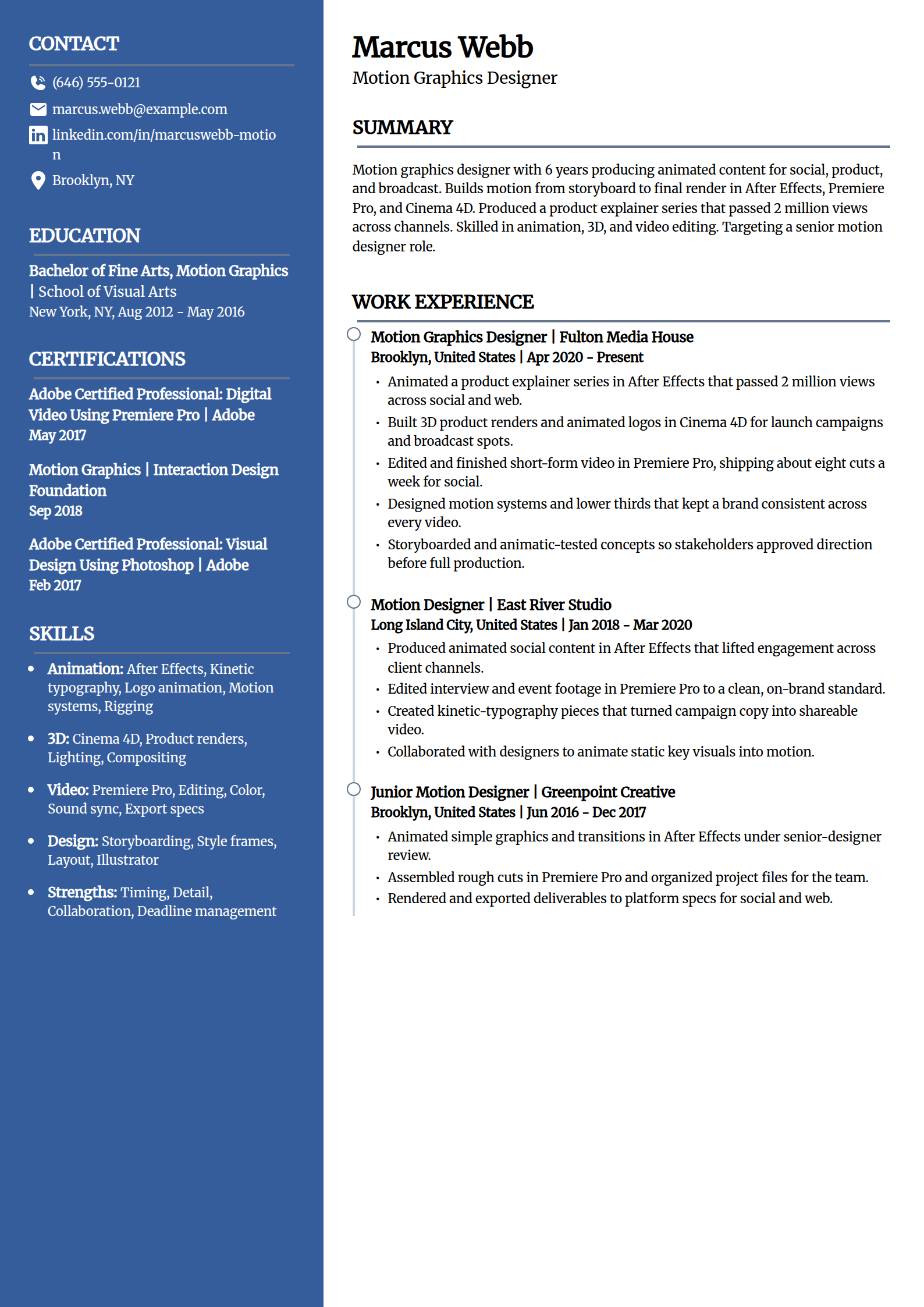
Motion Graphics Designer Resume Template
Why this resume example works?
- Opens with reach, an animated explainer series that passed 2 million views across social and web.
- Names the motion toolset a studio expects, After Effects, Premiere Pro, and Cinema 4D for 3D work.
- Shows the full pipeline from storyboard and animatic to final render, not just software familiarity.
- Keeps the specialty tight, motion systems and lower thirds that hold a brand consistent across video.
- Uses a visually rich layout that signals craft while keeping the experience easy to scan.
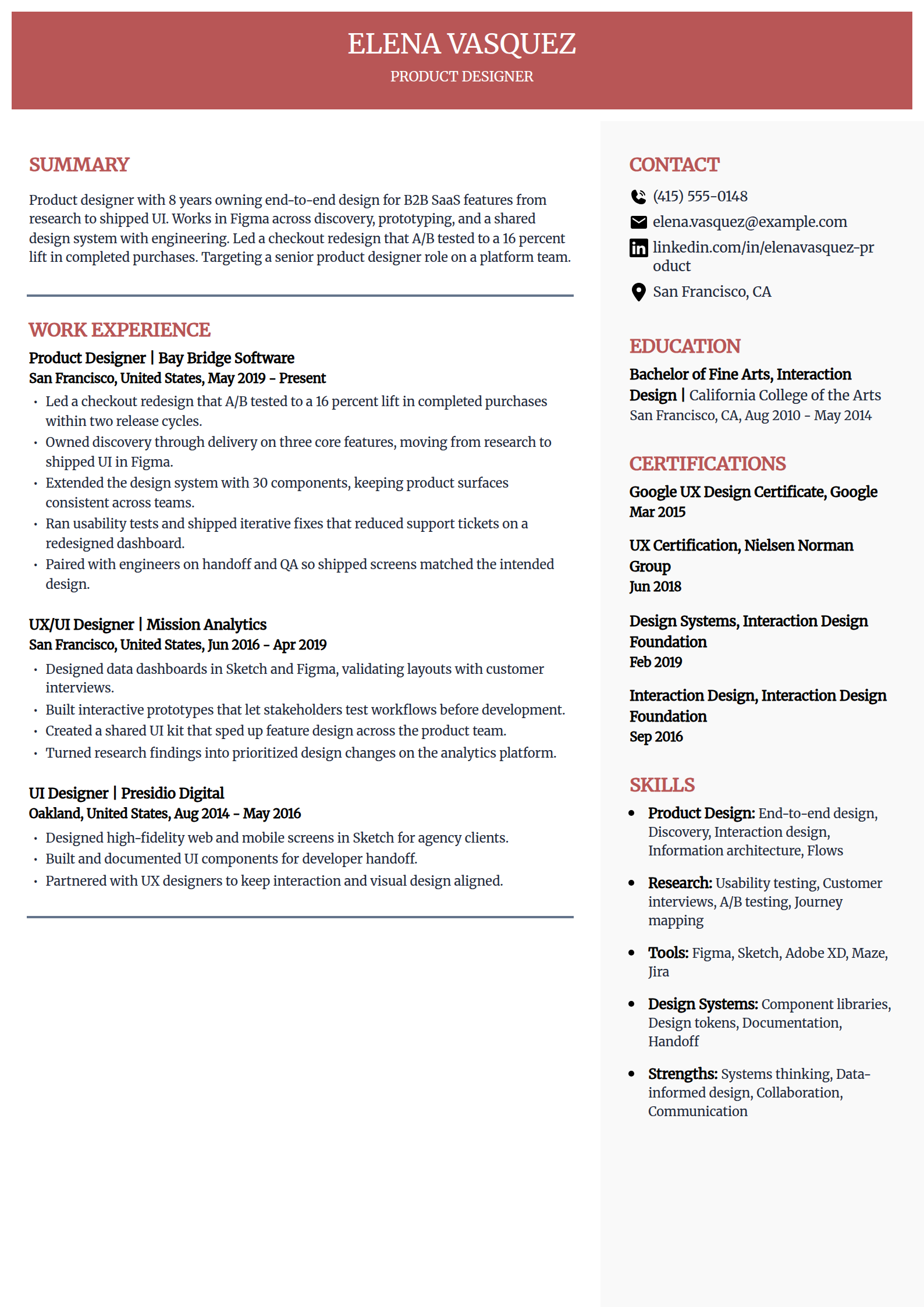
Product Designer Resume Template
Why this resume example works?
- Leads with a shipped result, a checkout redesign that A/B tested to a 16 percent lift in completed purchases.
- Shows end-to-end ownership, from research and prototyping to a design system extended with 30 components.
- Names the product-design stack, Figma, usability testing, and A/B testing, that a SaaS team screens for.
- Pairs design with engineering handoff and QA, proving the work ships rather than staying in a file.
- Uses a refined layout that fits an eight-year product history on one clean page.
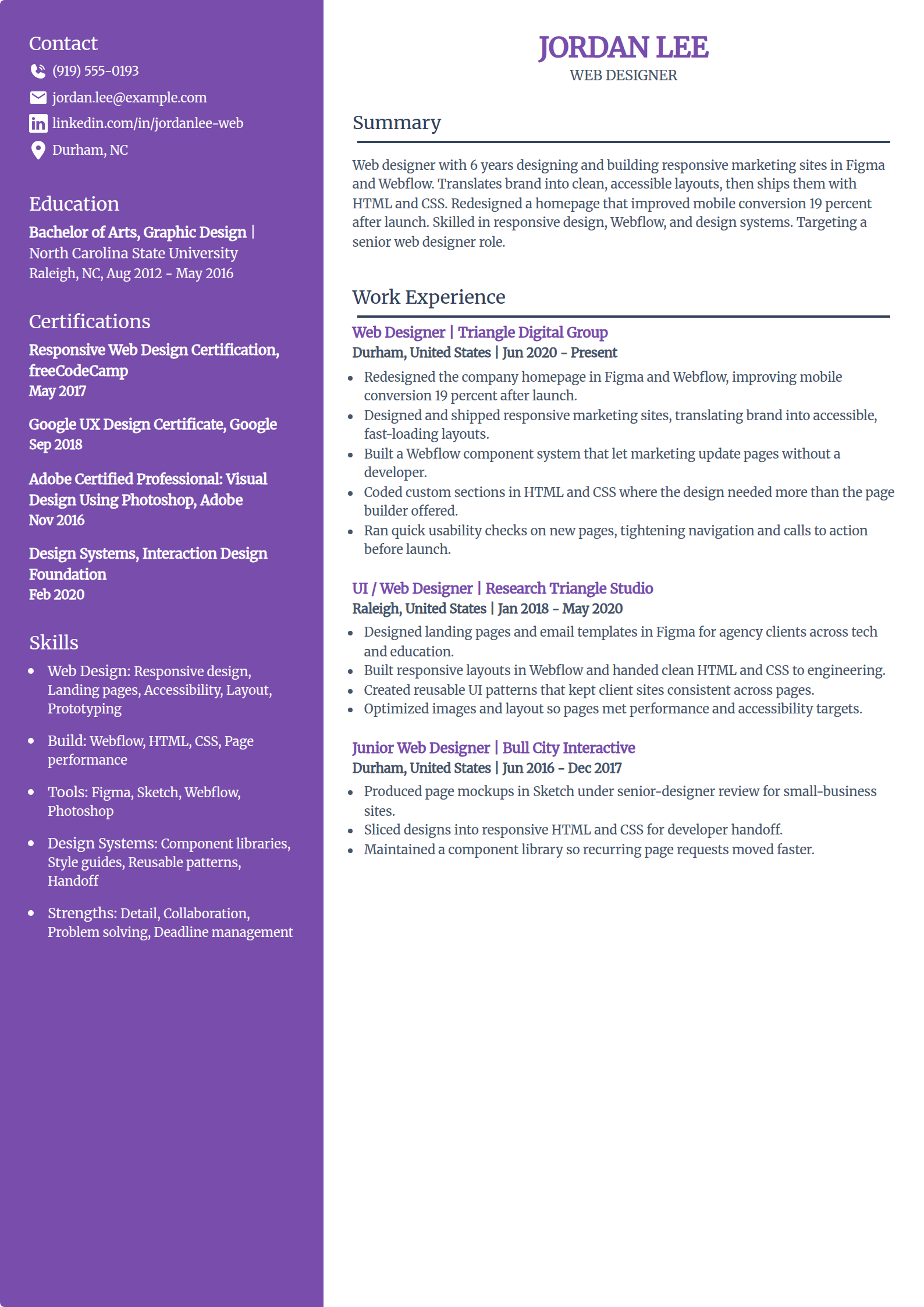
Web Designer Resume Template
Why this resume example works?
- Opens with a measurable win, a homepage redesign that improved mobile conversion 19 percent after launch.
- Names the web stack a posting lists, Figma, Webflow, and hand-coded HTML and CSS for custom sections.
- Shows the designer both designs and ships, building a Webflow system marketing can update without a developer.
- Keeps accessibility and page performance in the bullets, not just visual polish.
- Uses a clean, modern layout that parses well for in-house and agency web roles.
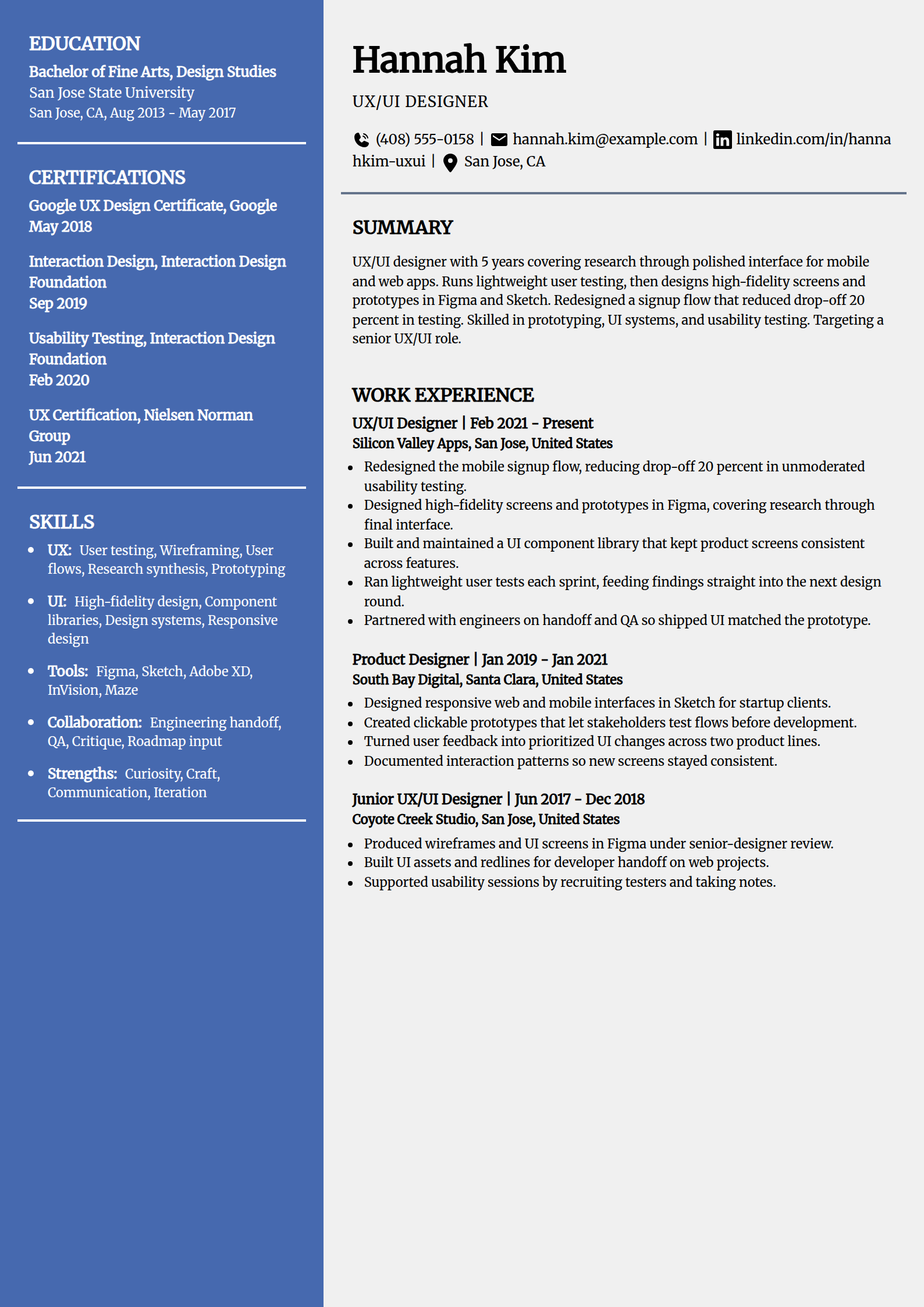
UX/UI Designer Resume Template
Why this resume example works?
- Leads with a flow redesign that reduced signup drop-off 20 percent in usability testing.
- Covers the full range the title implies, research through high-fidelity interface and prototypes in Figma and Sketch.
- Shows a maintained UI component library, the systems work that separates a mid-level designer from a beginner.
- Keeps user testing in the loop each sprint, proving decisions are evidence-based, not guesses.
- Uses a visually rich layout that shows interface taste while staying easy to skim.
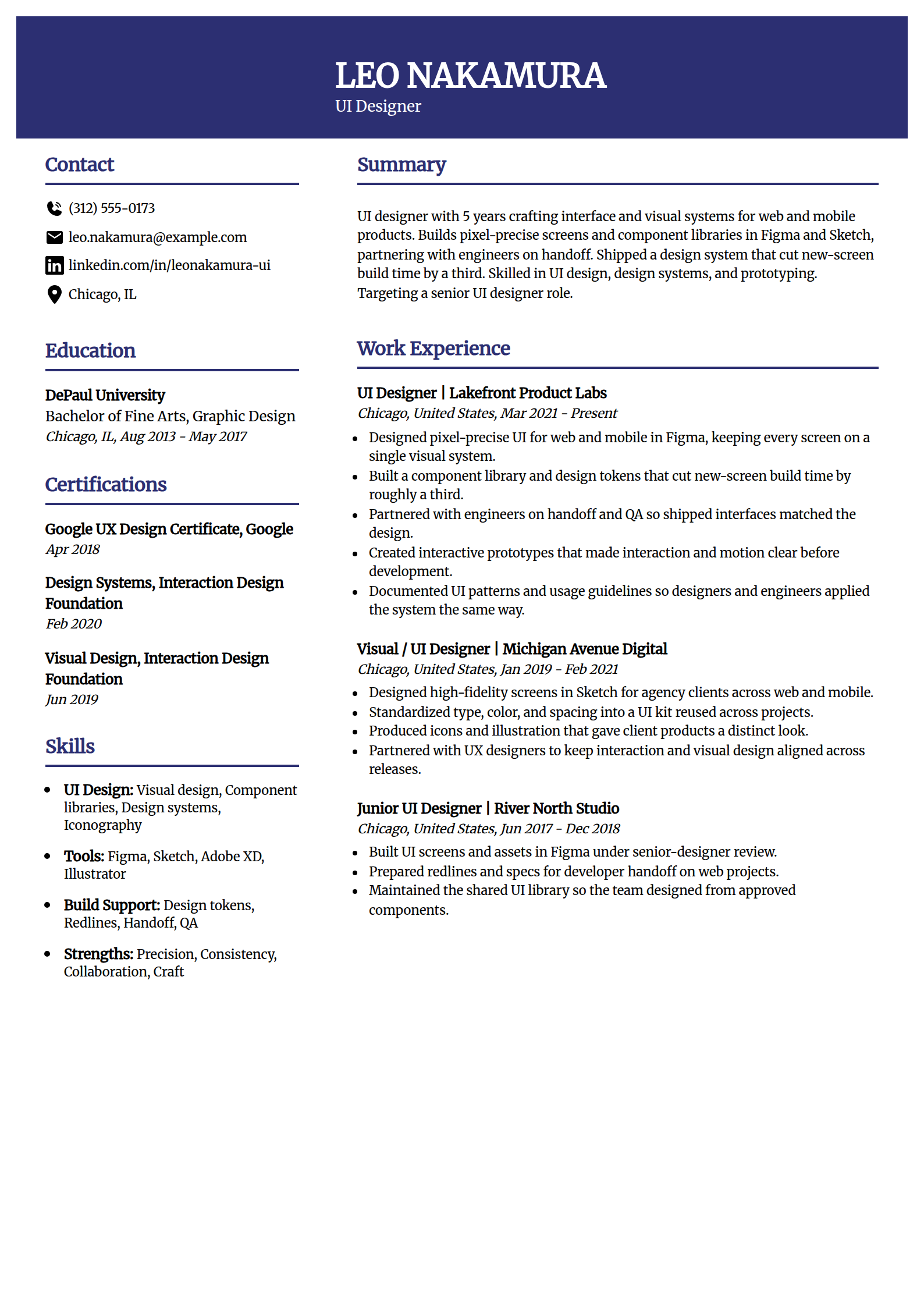
UI Designer Resume Template
Why this resume example works?
- Opens with a systems result, a design system that cut new-screen build time by roughly a third.
- Focuses on the UI craft, pixel-precise screens and component libraries in Figma and Sketch.
- Shows the engineering partnership, handoff and QA so shipped interfaces match the design.
- Uses a roomy two-column layout with the contact, education, and skills sidebar filled so the page reads complete.
- Keeps the scope believable for a five-year UI specialist rather than reaching for lead-level claims.
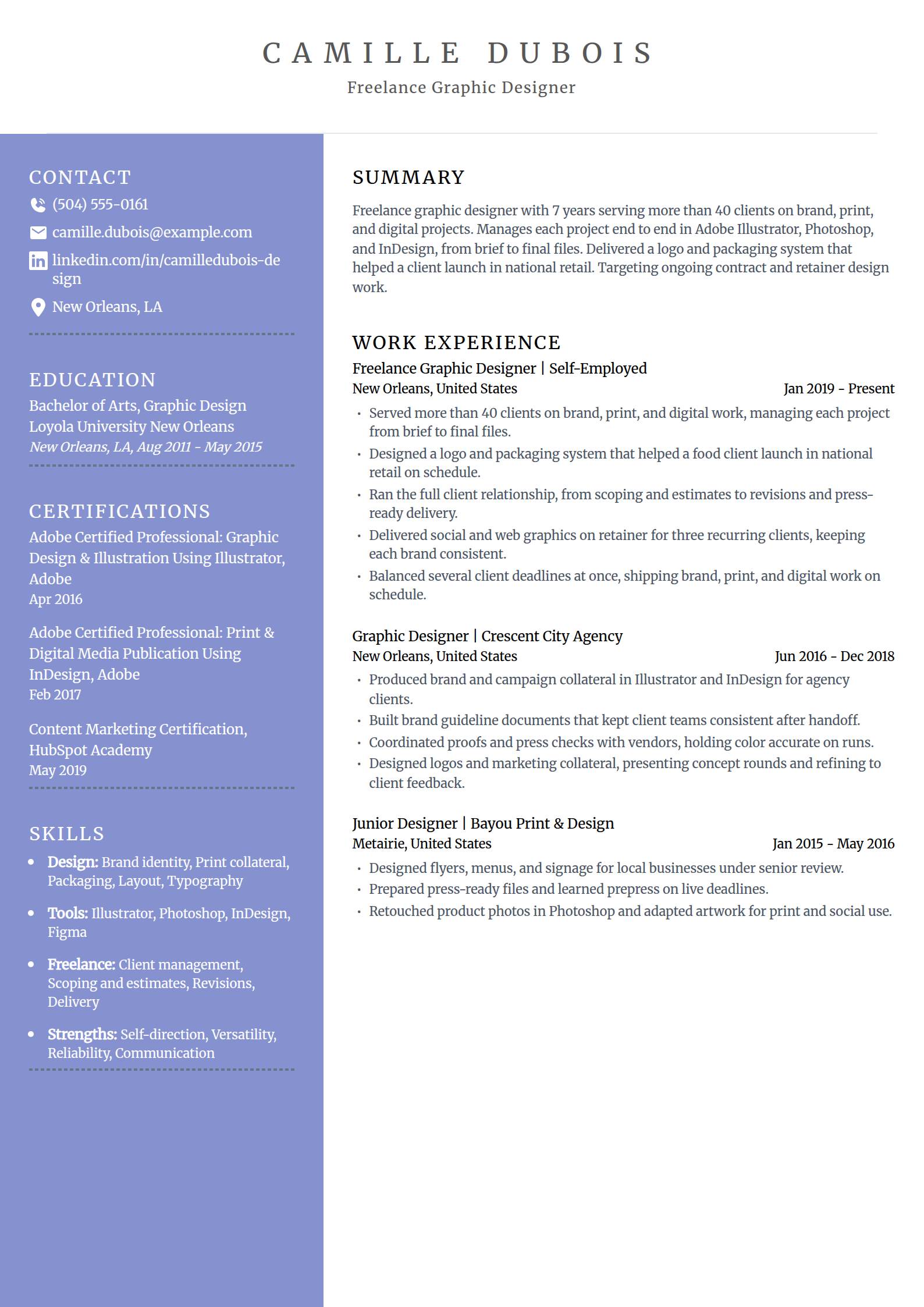
Freelance Graphic Designer Resume Template
Why this resume example works?
- Leads with breadth a freelancer must show, more than 40 clients across brand, print, and digital work.
- Names the whole Adobe toolset and the business side, scoping, estimates, revisions, and press-ready delivery.
- Anchors the range with a concrete win, a logo and packaging system that helped a client launch in national retail.
- Frames self-employment as a real role with a company line, not a gap, so the history reads clearly.
- Uses a roomy layout with a filled sidebar so a focused freelance history still looks complete.
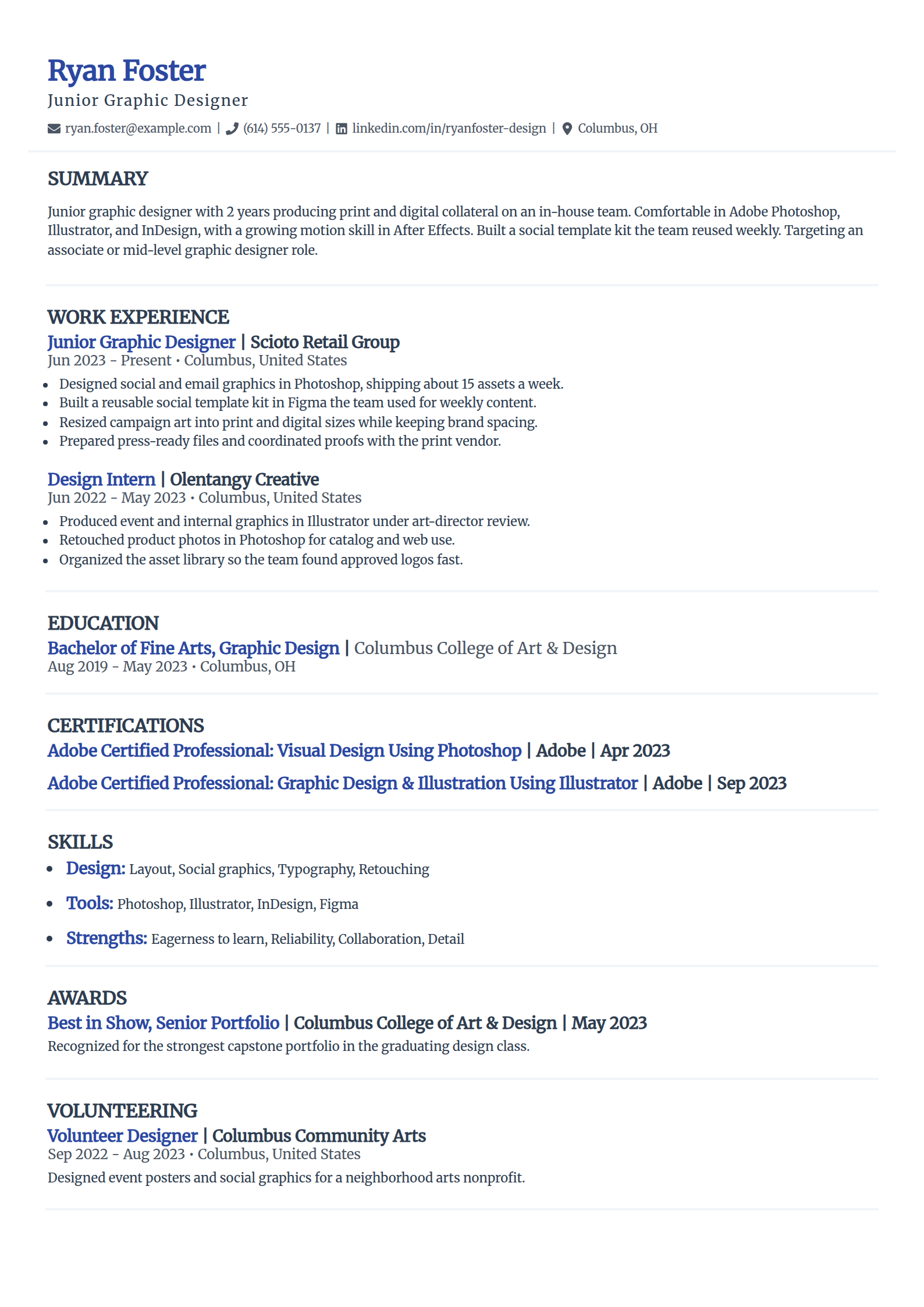
Junior & Associate Designer Resume Template
Why this resume example works?
- Written for two years in, leading with in-house production work and about 15 social assets a week.
- Shows a first reusable win, a social template kit the team adopted for weekly content.
- Names Photoshop, Illustrator, InDesign, and Figma so the fundamentals read clearly for a mid-level step.
- Fills the page honestly with a portfolio award and design volunteering rather than padding thin history.
- Uses a refined, ATS-safe layout that fits a shorter history on one clean page.
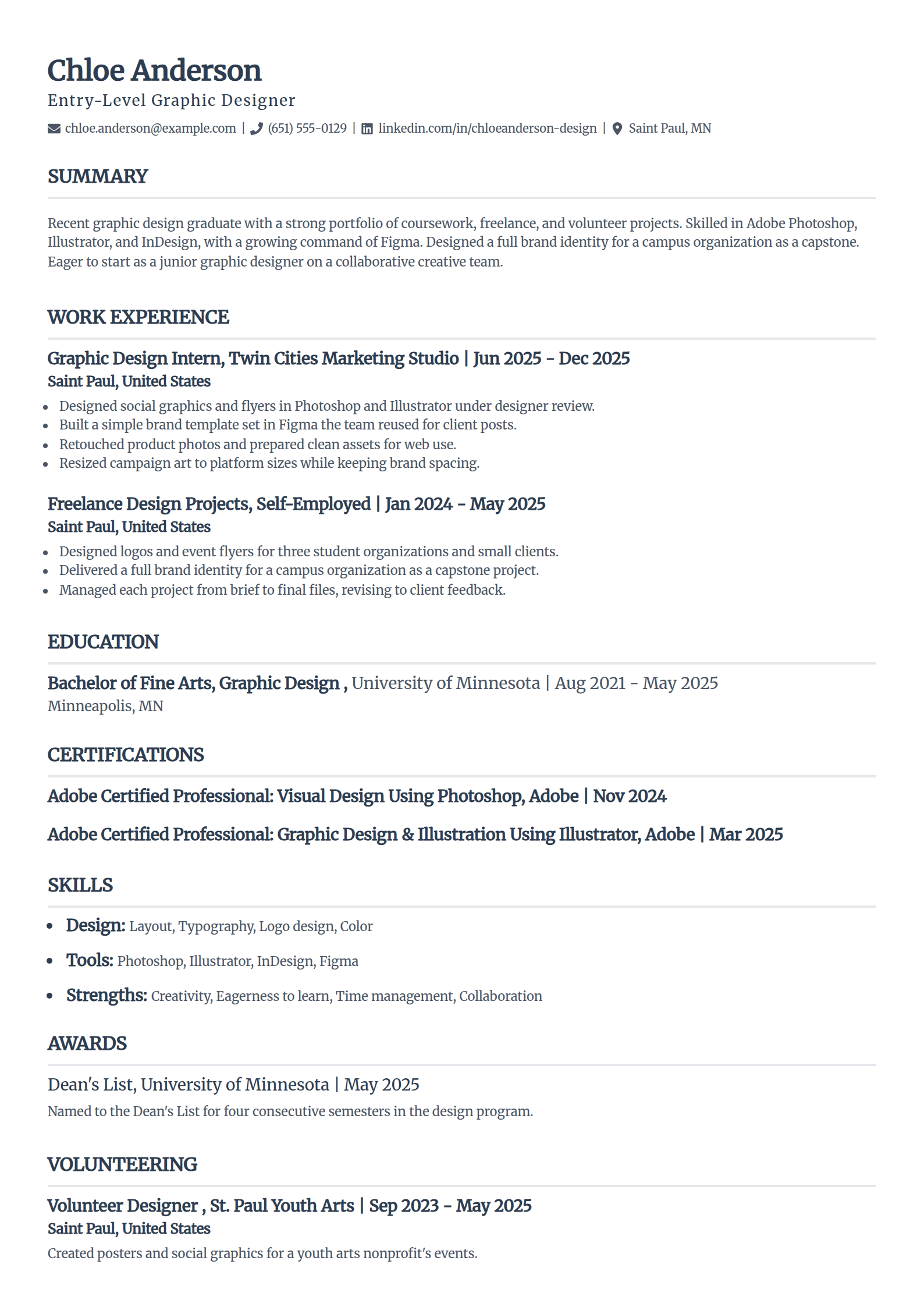
Entry-Level Graphic Designer Resume Template (No Experience)
Why this resume example works?
- Written for a first design job, leading with a strong portfolio of coursework, freelance, and volunteer projects.
- Uses an internship and freelance work to show real tasks, from social graphics to a full capstone brand identity.
- Names Adobe Photoshop, Illustrator, and InDesign plus a growing Figma skill so the toolset reads job-ready.
- Fills the page honestly with a Dean's List award and design volunteering instead of inflated bullets.
- Uses a tight, ATS-safe single-column layout that fits a beginner's resume without empty space.
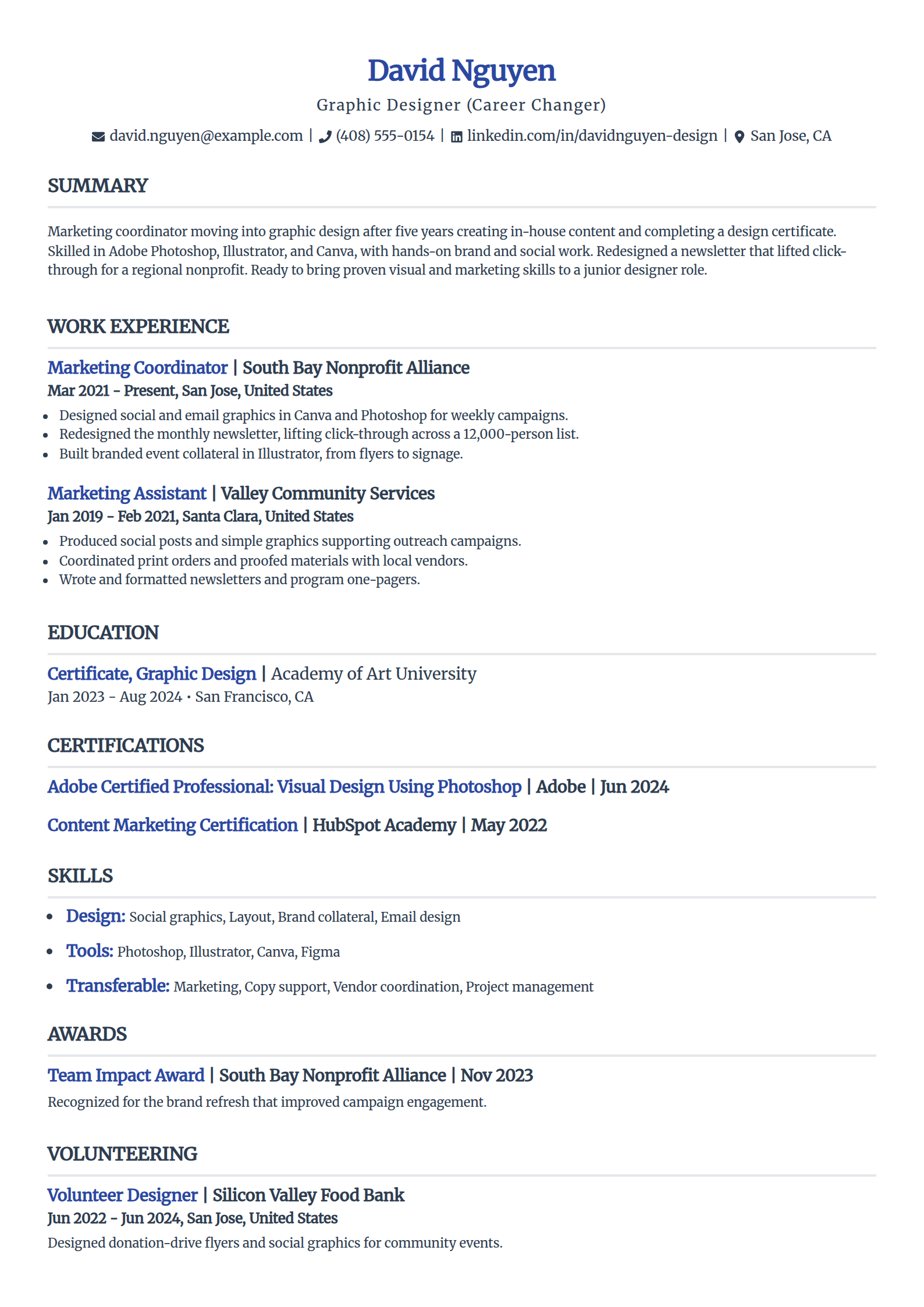
Career-Change Graphic Designer Resume Template
Why this resume example works?
- Names the change openly and reframes five years of marketing work as hands-on design experience.
- Pulls the transferable wins forward, a newsletter redesign that lifted click-through across a 12,000-person list.
- Shows recent commitment to the switch with a graphic design certificate and an Adobe credential near the top.
- Fills the page with a team award and design volunteering so the pivot reads intentional, not thin.
- Uses a plain, ATS-safe layout that keeps the focus on proven visual and marketing skills.
Build your graphic designer resume
Pick a template above, add your portfolio link to the contact line, and the editor keeps your layout clean and ATS-safe while you swap in your own tools, metrics, and projects.
Build my resumeHow to write a graphic designer resume in 2026
A graphic designer resume is read twice: once by a parser that only sees text, and once by a hiring manager who wants to click your work. Write for both. Lead with results and the tools you used, put your portfolio link where it is easy to find, and keep the file you upload clean enough to parse. The examples above show the shape for print, brand, UX, UI, motion, and web roles.
Open with a short summary that names your specialty and tools
Write three to four sentences that name your title and years, your specialty, one result with a number, the software you use, and the role you are targeting. A print designer and a UX designer read differently, so make yours specific to your track.
Graphic designer with 6 years producing brand and marketing collateral across print and digital. Ships about 25 layouts a sprint in Adobe Photoshop, Illustrator, and InDesign while holding brand guidelines steady. Redesigned an email program that lifted click-through 18 percent. Targeting a senior graphic designer role on an in-house creative team.
Lead experience with results, then the method and tool
The work a designer is hired for is concrete, so name the outcome and attach one number and the tool that produced it. Open every line with a strong verb, never "Responsible for".
- Impact: state what changed, like redesigning an onboarding flow that raised task completion 22 percent in usability testing.
- Volume: show scale where it fits, such as shipping about 40 social assets a week or building dielines for 80 packaging projects a year.
- Method and tool: name the software in the bullet, from Figma and After Effects to InDesign and prepress, so the parser matches it.
- One number per bullet, kept modest and believable for your level; not every line needs a metric, but at least half should.
Add your portfolio link, and make it easy to find
A designer resume is judged first by the work, and the work lives at a URL. This is the one field a designer resume cannot skip.
- Put one primary portfolio URL in the contact line, right next to the LinkedIn URL the examples above show, so it is visible without scrolling.
- Use a plain-text link like yourname.com or behance.net/yourname, not a hyperlinked image or button, because a parser reads text and ignores graphics.
- Pick one destination that shows your strongest and most relevant work; a Behance, Dribbble, or personal site all work if the work is current.
- Match the portfolio to the job: a UX role wants case studies with process, a brand role wants finished identity work.
List the tools and keywords for your track
A designer skills list should read like the job description, split so a hiring manager and a parser both find what they need. Name the exact software.
- Print and brand: Adobe Photoshop, Illustrator, and InDesign, plus typography, brand guidelines, and prepress or print production.
- UX and product: Figma, Sketch, and Adobe XD, plus user research, usability testing, wireframing, prototyping, and design systems.
- Motion and web: After Effects, Premiere Pro, and Cinema 4D for motion; Figma, Webflow, and HTML and CSS for web.
- Add credentials that fit your track, such as Adobe Certified Professional, the Google UX Design Certificate, or Nielsen Norman Group UX Certification.
Keep the uploaded version ATS-safe, and put the flair in the portfolio
Here is the honest tension for designers: a wildly art-directed resume signals taste but often breaks the parser, because text baked into images and heavy columns do not read. Separate the two jobs.
- For a resume you upload to a company portal, use a clean, text-based template with standard headings and a single-column or simple two-column layout.
- Keep your name, contact details, portfolio URL, and every bullet as real text, not inside a graphic, so the parser reads them.
- Save as a PDF so the layout holds, then run it through the ATS resume checker for a quick clean-format pass before you apply.
- Let the portfolio and the interview carry the visual flair; the resume's job is to get you past the parser and into the room.
Common graphic designer resume mistakes
- No portfolio link. A designer resume without a URL is incomplete; add one primary portfolio link to the contact line as plain text.
- A decorative resume that fails ATS. Text inside images and heavy multi-column art do not parse; keep the uploaded version clean and text-based.
- Listing tools with no outcomes. "Proficient in Photoshop" is a claim; "redesigned an email program that lifted click-through 18 percent" is proof.
- Opening bullets with "Responsible for". Lead with a strong verb, such as designed, redesigned, animated, built, or art-directed.
- One generic resume for every track. A print, UX, and motion role want different tools and results, so tailor the summary and skills to each.
Frequently asked questions
What should a graphic designer resume include?
A graphic designer resume needs your contact details with a portfolio link, a short summary that names your specialty and tools, your work history in reverse-chronological order, education, and a skills list. Lead the summary and each job with a concrete result and the software that produced it, such as designing a rebrand in Illustrator and InDesign or a redesign in Figma that lifted a measurable number. Name the exact tools for your track, add credentials like Adobe Certified Professional or the Google UX Design Certificate, and keep it to one clean page for most roles.
Do I need a portfolio link on my graphic designer resume?
Yes. A designer is hired on the work, and the work lives at a URL, so a portfolio link is the one field a designer resume cannot skip. Put one primary link in your contact line, next to your LinkedIn URL, as plain text like yourname.com or behance.net/yourname rather than a hyperlinked image, because an applicant tracking system reads text and ignores graphics. Choose one destination that shows your strongest and most relevant work, and match it to the job: case studies with process for a UX role, finished identity work for a brand role.
How do I make a graphic designer resume ATS-friendly?
Keep the version you upload to a company portal clean and text-based. Use a template with standard headings and a single-column or simple two-column layout, and keep your name, contact details, portfolio URL, and every bullet as real text rather than inside a graphic, because parsers cannot read text baked into images. Avoid heavy multi-column art and decorative fonts on the uploaded file. Save as a PDF so the layout holds, then run it through an ATS resume checker for a clean-format pass. Let your portfolio and the interview carry the visual flair.
How do I write a graphic designer resume with no experience?
Lead with your portfolio and the projects that fill it, even if they are coursework, freelance, or volunteer work. A capstone brand identity, freelance logos for student organizations, and an internship all show real tasks like designing social graphics or building a template kit. Name the software you know, such as Adobe Photoshop, Illustrator, and InDesign plus a growing Figma skill, and add a certificate like Adobe Certified Professional if you have one. Use a tight, one-page template and fill it honestly with an award or design volunteering, the way the entry-level example above does.
What is the difference between a graphic designer and a UX designer resume?
A graphic designer resume leads with visual craft and print or brand output, naming tools like Photoshop, Illustrator, and InDesign and results like a rebrand or a package rollout. A UX designer resume leads with process and product impact, naming user research, usability testing, wireframing, and prototyping in Figma, and results like an onboarding redesign that raised task completion in testing. Both need a portfolio, but a UX portfolio shows case studies with process while a graphic-design portfolio shows finished work. Tailor the summary, skills, and examples to the track you are applying for.
What skills and software do you put on a graphic designer resume?
Match the skills to your track and name the exact software. For print and brand roles, list Adobe Photoshop, Illustrator, and InDesign plus typography, brand guidelines, and prepress. For UX, UI, and product roles, list Figma, Sketch, and Adobe XD plus user research, usability testing, wireframing, prototyping, and design systems. For motion, add After Effects, Premiere Pro, and Cinema 4D; for web, add Webflow and HTML and CSS. Split the list so a hiring manager and a parser both find what they need, and mirror the wording of the job posting.
More graphic designer resume resources
Build your graphic designer resume
Pick a template above, add your portfolio link to the contact line, and the editor keeps your layout clean and ATS-safe while you swap in your own tools, metrics, and projects.